

In partnership with

The $12k seat I cut from my agency this quarter wasn't a designer. It wasn't an editor. It was a content lead… and the thing that replaced them costs me about $30 a month.
It's called Slideshow Kit. Open source. MIT. Free. Link at the bottom.
It runs daily social on autopilot. Reads your brand's DNA, watches what's trending today, ranks concepts before it writes a single slide, picks a format with real rules, drafts the script, directs the visuals slide-by-slide, and ships through Postiz. Drafts by default. Autopilot once you've earned it.
Today's trends → Brand DNA lens → Ranked concepts → Format-locked script → Scene direction → Render → Postiz → ShipTrend signal in. Point of view applied. Save-worthy carousels out, every day.
Marketing isn't a department anymore. It's engineering. And the calendar finally broke under the weight of that fact.

Sponsored
Speak naturally. Send without fixing.

Wispr Flow turns your voice into clean, professional text you can send the moment you stop talking. Not rough transcription you have to clean up. Actual polished text — ready for email, Slack, or any app.
Speak the way you think. Go on tangents. Change your mind mid-sentence. Flow strips the filler, fixes the grammar, and gives you text that reads like you spent five minutes writing it.
89% of messages sent with zero edits. Millions of professionals use Flow daily, including teams at OpenAI, Vercel, and Clay. Works on Mac, Windows, and iPhone.
Why I had to build it
Your feeds are hungry every morning.
LinkedIn wants daily. Instagram wants daily. TikTok wants daily. X wants hourly. Threads. Bluesky. The list keeps growing and the calendar doesn't. Distribution is the moat, and the moat needs filling every single day.
So operators turn to AI. And here's where it goes sideways.
AI wants to default to mediocre. And mediocre is the enemy of good.
Most AI carousels in the feed right now look like every other AI carousel. Six slides. Stock backgrounds. The kind of post you scroll past without remembering it was there. Technically correct. Emotionally dead. The model has nothing to pull from except the average of everything.

I almost killed this project in March for exactly that reason. The first runs spat out the same generic boring stuff every other AI tool ships. I had to fix it before it was worth releasing. And the fix wasn't a better prompt or a smarter model. The fix was teaching the agent my taste.
Let me back up.
The carousel I tried to copy
A few years ago I was scrolling the feed and Oren John posted a carousel.
Glorious design. Beautiful layout. The kind of post you stop on. I tried to make one myself. Took me hours. Mine looked like trash next to his. So I started a swipe file. Dickie Bush. Other creators with signatures you could spot from a thumbnail before reading a word. I kept saving them.
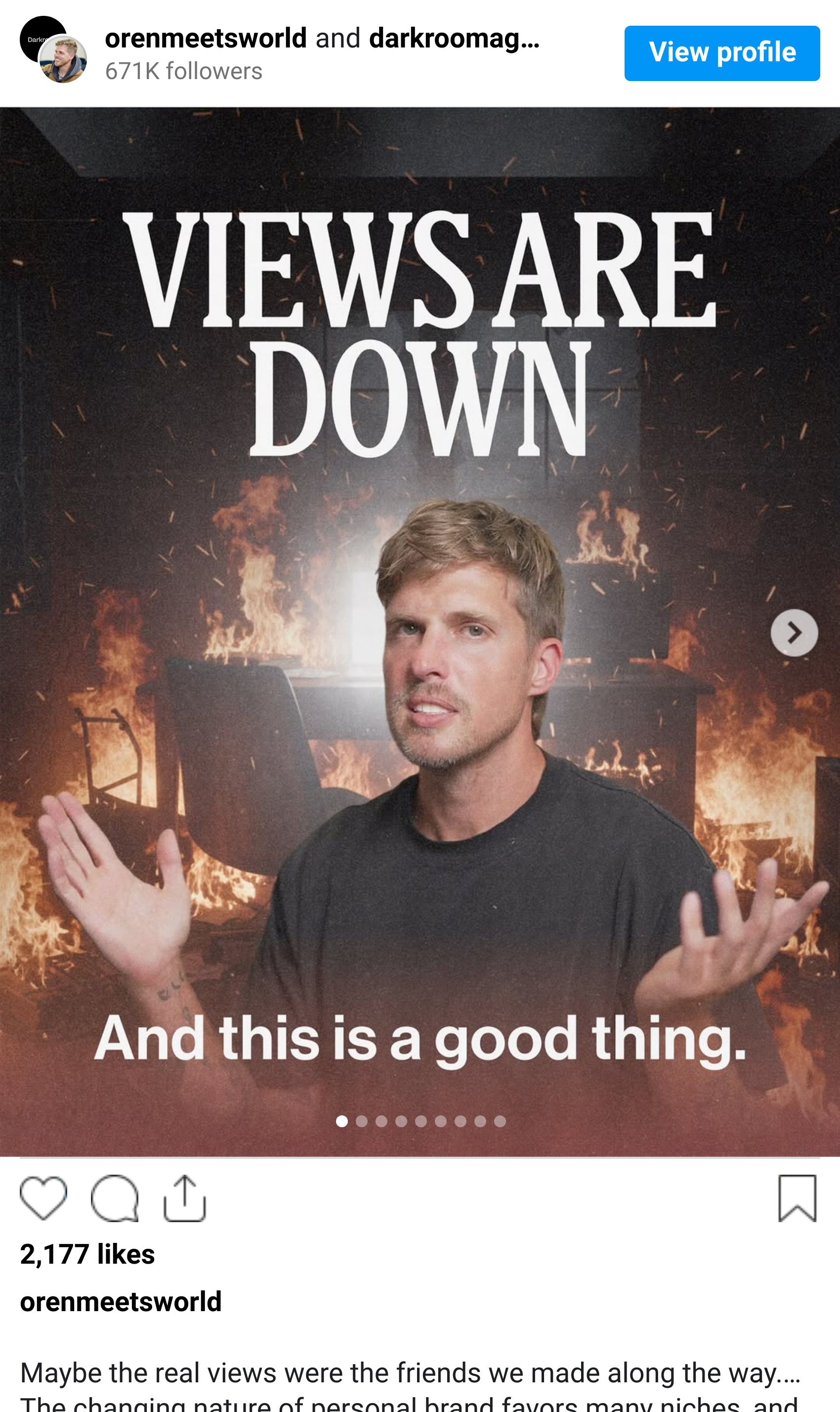
I obsessed over what made those posts different. It wasn't the writing. It wasn't even the design system. It was taste, a thousand small decisions layered on top of each other until the post felt inevitable. You can't prompt taste. You have to build it.
Last year I built an internal tool to automate carousels for our agency. Outputs came out great. Millions of views. The brands running on it felt the lift. Creative testing and volume matter more than ever, and we were finally keeping up.
Then a few months ago I saw other operators jumping into the carousel game with their own agentic systems. I liked what I saw. I didn't love it. I thought I could make something cooler.
But the v1 had a flaw I couldn't fix without help. It relied on the user to know what was happening in their niche, what was trending, what people were actually talking about right now. I can't ask one person to know everything popping off across millions of conversations. The world moves faster than any one person can read. Models train on stale data. The operator is one human doing too much.
So I built the gap-closer. That's the kit you saw above.
the lane humans can still win
A real personality video can't be faked (and you shouldn’t). If your founder can sit on camera and sound like a founder, that's a moat. Don't AI-UGC over that.
But you can't film one human 15 times a week, testing hooks, formats, and everything else. The video lane has a hard human ceiling and the feeds don't care.
That leaves the volume problem nobody owns. Thousands of posts. Hundreds of accounts. Dozens of channels. We only have so many hours in a day.
Carousels win this lane. You can ship them. You can test them. You can still tell stories. The reader takes their time, scrolls at their own pace, and listens to a podcast in the background while they read. Your carousel doesn't fight for their AirPods. That's a different deal than a video makes with a feed.
The volume war is rigged against humans. Carousels are how humans win it back.
slideshow-kit daily-loop output:
trends → check-in → DNA lens → ranked concepts → format-locked script → scene direction → render → postiz drafts
Get it free, open-source, below (scroll to the bottom).
two stacked layers, not one blob
The kit thinks about a carousel as two stacked layers:
→ Format is the narrative structure. Seven of them ship with the kit, each with explicit slot rules and word caps so a "4 tells" post can't quietly drift into a 6-tells post by slide 5.
→ Style is the look. Your signature visual identity. The thing that makes your carousels recognizable from a thumbnail before anyone reads a word.
You mix the two however you want. Same brand, same style, seven different format moves depending on what today's trend deserves.
The seven formats:
→ Narrative. Story-driven lessons, founder POV, case studies.
→ Numbered diagnostic. "The 4 tells", "5 reasons your X is broken."
→ Receipt + context. Quote, screenshot, or claim followed by your read.
→ Process reveal. "How I did X in N minutes" workflows.
→ Anatomy breakdown. Teardowns, examples, what-to-notice posts.
→ Before / after. Old way vs. new way contrast.
→ Counter narrative. Contrarian takes on category orthodoxy.
The operator picks which format runs per trend per day, or just tells the agent what they want and lets it decide.
YOU are the storyteller. the agent's the engine.
Most AI carousel tools want to be the storyteller. They generate the angle, the hook, the slides, the captions. The output is technically right but emotionally dead because, say it with me, AI wants to default to mediocre.
Most carousels you scroll past spit out facts over generic stock backgrounds. And to their credit, some get views. Do they convert? I don't know. Do they make somebody fall in love with the brand? Almost never.
I'm not here to recite Wiki facts. I'm here to make somebody feel something.
The agent can't always figure out the story for you. But if you have a story to tell, it can be the engine that tells that story on loop. That's a different product. A taste-curated engine, not a storyteller. You stay in charge of what gets said.

The whole work is teaching the agent your taste.
When I built the early versions in OpenClaw, the first run made the same generic stuff every other AI tool makes. So I asked it for ten versions. I gave feedback on every single one. This one. Not this one. This is too on-the-nose. This is closer. Make ten more in the direction of slide 4. Then again. Then again.
That feedback loop is what builds the kit. Not a prompt. Not a model. Not a pipeline. The taste.
Slideshow Kit ships with a brand DNA contract that turns that taste loop into something portable. Four files per brand:
→ Voice. How the brand actually talks.
→ Perspective. What it believes. Pillars, hot takes, ICP.
→ Visual system. Palette, typography, layout, output sizes.
→ Corpus loader. If you already keep brand notes in the usual places, the kit finds them. You don't have to re-author what's already written down somewhere.
The kit reads those files directly. Every sub-skill does too. The brand state never gets duplicated or vendored inside the kit. Your voice stays yours. The kit is the engine that runs your voice on loop, not a vendor that holds it hostage.
Concepts before slides
Here's the part most AI carousel tools skip, and it's the part that decides whether anyone saves the post.
Most tools write slides from a prompt. Slideshow Kit ranks concepts first, then writes slides from the winning concept.
Each concept comes with a format pick, an arc, a close action, multiple hook variants, a visual hook, and a save-worthiness score. You pick the concept. Then it drafts. You don't get one shot at a slide deck. You get a slate.

Two details that matter more than they sound:
→ Each concept carries a personal-fact risk flag. Autopilot skips concepts that would put a specific claim about you in your mouth. The model never decides on its own that you "raised $4M" or "left McKinsey." If it can't verify it from your DNA files, it won't ship it.
→ The format and the concept are locked before the slides get written. So the post can't quietly drift from "5 tells" to "6 tells" to "and here's a story" by slide 4. The format has slot rules. The lint chain enforces them.

visuals are planned, not decorated
The kit doesn't go straight from script to image.
Between the script and the render sits a scene director. One small LLM call that writes a specific visual brief per slide, based on the script, your style spec, and the character profile if you're running a character-driven look. The render step gets a directive, not a guess.
That's why six slides in a kit run actually feel like one post instead of six unrelated images that happen to share a palette. The visuals carry the argument. They aren't ornaments stapled onto words.
The first three runs we did across one of our clients tanked their bookmark rate. The scene director didn't exist yet. The lint chain didn't exist yet. Slides were technically correct and visually disconnected. That's why both exist now.
Failure is the spec sheet. Every guardrail in this kit is a scar.
your signature look, on every post
Brand DNA tells the kit how you talk and what you believe. Format tells it what shape the post takes. There's another layer on top of that, what your content looks like in the feed.
Styles. Your own signature look. The visual personality that makes your carousels recognizable from a thumbnail before anyone reads a word. Dickie Bush has one. You can spot a Dickie Bush carousel from across the feed without seeing the face. That's a recognizable style.

The kit lets you build yours and run it on every post that comes after. Drop a few carousels you love into a folder. Tell the agent "make mine feel like that." It writes the spec, saves the references, and from then on every carousel you ship runs through that style. Teach it once. Yours forever.
How it works:
→ Each style is a small folder. A spec file (DESIGN.md) with structured tokens up top for precise constraints, prose below for the look-and-feel, plus a refs subfolder holding reference images.
→ Style settings inherit cleanly: kit defaults sit underneath, the brand's visual-system sits on top of those, and the style itself sits on top of the brand. Override only what you need to.
→ At generation time, the kit composes the constraints, the prose verbatim, the per-slide caption and layout intent, and the refs piped straight into the image model's reference-image slots.
→ Authoring is conversational. Tell the agent what the look is ("dark cinematic, gold serif"), drop a reference image, or both. The agent writes the spec, saves your refs, and generates one synthetic reference so you can confirm the look before you commit.
→ Each brand carries a default style. A style override per run is one line.
The "branded carousel" and "social-native, iPhone-real, recurring-character" looks I used to ship as fixed formats are now just two example styles. You can build your own. You can build five.
save-worthy or it doesn't ship
Bookmark rate is the leading metric on every thread, carousel, and article we ship. Views are vanity. Saves are intent.
So the kit runs a save-worthiness filter on every draft before it leaves the loop. If a draft doesn't read like something a real human in your ICP would save, the kit flags it before Postiz ever sees it.
the daily loop
If you've made it this far, you want to see the orchestration. Most AI tools show you the output and hide the wiring. Here's mine.
┌─────────────────────────────────────────────────────┐
  │              SLIDESHOW KIT DAILY LOOP                 │
  │                                                       │
  │   1.  Load brand DNA                                  │
  │   2.  Live-spend gate (drafts default)                │
  │   3.  Pull today's trends                             │
  │   4.  Daily check-in (Telegram or in-session)         │
  │   5.  Generate ranked concepts + hook variants        │
  │   6.  Pick concept, draft format-locked script        │
  │   7.  Write per-slide scene direction                 │
  │   8.  Render configured styles (PNG)                  │
  │   9.  Build Postiz payloads                           │
  │  10.  Log the run + increment run count               │
  │                                                       │
  └─────────────────────────────────────────────────────┘
Run it manually by asking your agent. Run it on a schedule (a cron) at 9am every day. Run it across a dozen brands in a single shell loop. The workflow is markdown. The host agent reads it (Claude Code, Codex, OpenClaw, Hermes). You can also run it as a plain local checkout with no host agent.
Two pieces of plumbing matter more than they sound. The Telegram bot wrapper and the Postiz wrapper are decoupled with distinct exit codes. A Telegram outage never blocks publishing. A Postiz outage never blocks the alert. Per-slide rendering is resilient too. If one slide fails, the loop logs it, keeps going, and writes the partial output. You see exactly which slide failed and why instead of losing the whole pack to a single timeout.
The loop ships even when one rail is down.
Postiz earned its position
Slideshow Kit's publishing layer composes Postiz. Open-source social scheduling that fans out across LinkedIn, X, Instagram, Threads, TikTok, YouTube, Bluesky, Mastodon, the works. One CLI. Every channel that matters.
Worth knowing the backstory because it's the move every operator reading this should study.

Nevo built Postiz, shipped through years of slow growth, stuck around $2-4k MRR. Kept shipping. Came back from side projects. Kept shipping. Then the n8n and social-automation wave hit and MRR finally moved. Then agents hit. Within days he had a CLI and an agent surface ready to go. Big X articles dropped. He took off.
He's clearing about $90k MRR now. ~$1.08M ARR. One-man operation. Open source. I run a copy on my Synology at home.
Ship every week for years through slow growth, and when the wave finally arrives, you're ready for it. Watching builders build is one of the best things in this game.
The kit drops carousels into Postiz as drafts by default. One approve click fans them out across every channel you've connected. Autopilot ships them scheduled when you've earned the run history.
If you build marketing systems and you're not running postiz, you're paying SaaS rent for something open source does better. Run it. Star the repo. Send Nevo something nice on X.

the cost flip
If you've made it this far you're probably doing the math in your head. Let me do it for you.
THE OLD WAY                          THE AGENT WAY
─────────────────────────────────  -----------------------
Content lead:           $12,000      Slideshow Kit:   free
Designer (carousels):    $3,000      Image gen: ~$0.10/slide
Time per carousel:      2-4 hours    Postiz:      free
                                     Time /carousel: minutes
─────────────────────────────────  ────────────────────────────
ONE BRAND, ONE MONTH:  ~$15,000      ONE BRAND/ONE MONTH: ~$30
A real content lead still wins for the centerpiece campaigns. Nothing replaces a senior writer when the post is the centerpiece.
But the centerpiece is 10% of your feed. The other 90% is daily LinkedIn, weekly Instagram, the carousel pile your TikTok needs to stay interesting, the brand-pillar reminders, the IG variant. That work is what this kit eats.
For an agency, the math compounds across brands. We've gone from N to 20-50N output in the last twelve months. That's not a marketing claim. That's the line item.
Field notes
Four things I've learned shipping this on real feeds. The kit doesn't teach you these. The reps do.
→ Saves > views. Trust the lint chain. If it flags a draft three times in a row and you ship anyway, your bookmark rate will tell you the same thing the kit already told you.
→ TikTok wants drafts. Don't auto-publish to TikTok from the API. Push as drafts and finish the work in-app.
→ Warm up new accounts before you ship volume. A brand new account cranking out 5x daily looks like a bot to every algorithm. Build human-shaped activity for two weeks first. Jack Frick on X has the right primer.
→ Eat your own dogfood for at least seven runs. That's also the autopilot gate. The kit won't let a brand spend or schedule unattended until it has seven runs of draft history.
who this is for
Run this kit if:
→ You're an agency or operator running social for more than one brand and the calendar math broke
→ You're a founder who knows distribution is the moat and you can't keep up by hand
→ You've got brand DNA you can articulate (voice, perspective, visual system) and you want it run on loop → You're already running Brand Shoot Kit, Creator Breakout Kit, or Outcome Kit and need a daily distribution engine that ships what those kits produce
Not for you if:
→ You're a solo creator with one channel and one human voice you record daily. Keep doing that, you're winning
→ You already have a senior content lead writing five carousels a week with great taste and a tight feedback loop. Keep them
→ You want a carousel toy that ships ten viral posts on day one without you giving it your taste. That's the average AI does on its own, and it's not what this is
get the kit
Full system free on GitHub:

The installer detects your installed agents (Claude Code, Codex, OpenClaw, Hermes) and installs the kit to each.
Three clusters of what you're getting:
THE ENGINE → The daily-loop orchestrator (trends → DNA lens → concepts → script → scene direction → render → postiz) → A concept generator that ranks angles, drafts hook variants, scores save-worthiness, and flags personal-fact risk before any slide gets written → Seven format-locked carousel structures with per-slot lint rules → A scene director that writes one visual brief per slide before render
THE TASTE LAYER → The brand DNA contract (voice, perspective, visual system) plus a corpus loader that auto-finds notes you've already written elsewhere → The styles system — your signature look, authored conversationally, run on every post → A lint chain with a save-worthiness filter so low-bookmark-rate drafts get flagged before postiz sees them
THE PLUMBING → Live-spend gating (drafts default, autopilot opt-in after seven runs per brand) → Decoupled telegram + postiz wrappers (independent failure domains) → Resilient per-slide rendering, multi-brand workspaces, cross-agent install → A structured run packet on disk so every run is auditable → A smoke-eval harness and a built-in health check
You'll need an OPENAI_API_KEY for live image generation, postiz CLI auth for publishing, and optionally a Telegram bot token for the morning check-in. Dry-run path needs no keys.
Setup is about an afternoon. Paste five to ten of your best posts and the kit extracts your DNA. Run a draft-mode loop tomorrow morning. Ship from postiz with one approve click. Watch the output for a week. Then flip to autopilot.
Marketing isn't a department anymore. It's engineering. You're not just building product. You're building the marketing engine that ships it.
It's not about manually pushing pixels. It's about managing the systems that push the pixels for you.
If your feed is hungry every morning, this is the kit that feeds it.
Go big,
Matt
P.S. Slideshow Kit is the daily distribution engine. If you're already running Brand Shoot Kit, Creator Breakout Kit, Outcome Kit, Landing Page Factory, or SEO Kit, this is the kit that takes what they produce and ships it to your feeds every day. Brand Shoot makes the visuals. Creator Breakout decides the angles. Outcome Kit tells you which ones work. Slideshow Kit posts them.
P.P.P.S. Star the Slideshow Kit repo if this helps. It tells me to keep building.